You’ve felt it before — that cool, tingling sensation when you apply a pain relief cream. It feels like it’s working almost instantly, and there’s good reason for that. The ingredient responsible for that characteristic cooling effect is menthol, and it’s one of the most thoroughly studied topical analgesic ingredients in the world.
What Is Menthol?
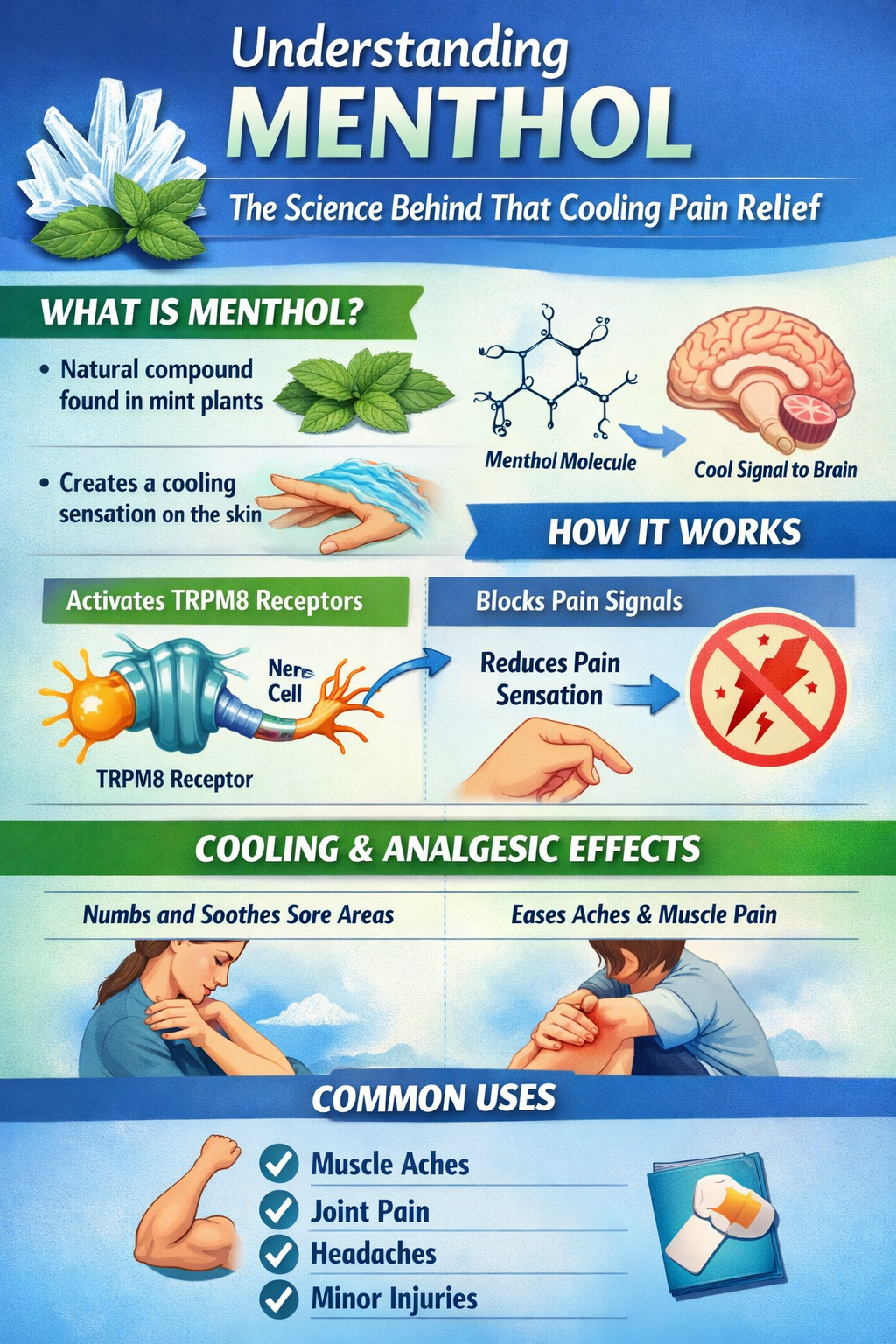
Menthol is a naturally occurring compound found primarily in peppermint and other mint plants. It’s been used for medicinal purposes for thousands of years across cultures, from traditional Chinese medicine to European apothecaries. Today, it’s one of the most common active ingredients in over-the-counter topical pain relievers — and modern science has helped us understand exactly why it works.
Menthol can be derived naturally from mint oil or produced synthetically, and both forms are chemically identical. The FDA recognizes menthol as a safe and effective OTC topical analgesic ingredient when used at concentrations between 1% and 16%.
How Menthol Creates That Cooling Sensation
The cooling effect of menthol isn’t just a pleasant sensation — it’s a specific biological process. Menthol activates a protein called TRPM8 (Transient Receptor Potential Melastatin 8), which is a receptor found in sensory nerve endings in your skin.
TRPM8 is the same receptor that detects actual cold temperatures. When menthol binds to these receptors, it triggers the same neural pathway that real cold would — sending a “cold” signal to your brain. This is why menthol feels cool even though it doesn’t actually change the temperature of your skin.
This receptor activation does more than just create a sensation. Research has shown that TRPM8 activation can:
- Reduce the perception of pain in the applied area
- Decrease the firing rate of pain-sensing nerve fibers
- Create a mild local anesthetic effect
- Promote increased blood flow to the area
The Gate Control Theory: Why Cooling Blocks Pain
One of the key mechanisms behind menthol’s pain-relieving effect relates to the gate control theory of pain, first proposed by Melzack and Wall in 1965. This theory suggests that the nervous system can only process a limited amount of sensory information at once.
When menthol activates cold receptors in your skin, those signals travel along fast-conducting nerve fibers to your spinal cord. These non-painful signals effectively “close the gate” to slower-moving pain signals, reducing the amount of pain information that reaches your brain.
Think of it like this: your nervous system has a limited bandwidth. By flooding it with a strong cooling sensation, there’s less capacity to transmit pain signals. The result is a noticeable reduction in discomfort at the application site.
Menthol and Blood Flow
Beyond its effects on nerve receptors, menthol also influences local blood circulation. When applied to the skin, menthol initially causes a brief vasoconstriction (narrowing of blood vessels), followed by vasodilation (widening of blood vessels). This increased blood flow can help:
- Deliver nutrients and oxygen to sore tissues
- Remove metabolic waste products that contribute to muscle soreness
- Reduce localized swelling and inflammation
- Speed up the body’s natural recovery processes
This dual action — pain signal modulation plus improved circulation — is part of what makes menthol such an effective topical analgesic ingredient.
What the Research Shows
Menthol’s effectiveness isn’t just anecdotal. Peer-reviewed research has consistently supported its use as a topical pain reliever:
- A study in the Journal of Clinical Rheumatology found that topical menthol provided significant pain relief for osteoarthritis of the knee.
- Research in the International Journal of Sports Physical Therapy demonstrated that menthol-based topical analgesics reduced perceived pain intensity during and after exercise.
- Multiple studies have confirmed menthol’s safety profile when used at appropriate concentrations, with minimal systemic absorption and rare adverse effects.
This body of evidence is why menthol continues to be one of the most widely recommended topical analgesic ingredients by healthcare professionals. For more details, see our Science & Ingredients page.
Menthol in Combination: A Multi-Mechanism Approach
While menthol is effective on its own, it can be even more powerful when combined with complementary ingredients. Camphor, for instance, adds a warming counterirritant effect, while methyl salicylate contributes its own analgesic and anti-inflammatory properties at the application site.
This multi-ingredient approach targets pain through several mechanisms simultaneously, potentially providing more comprehensive temporary relief than any single ingredient alone.
TPR20: Menthol-Based Pain Relief You Can Trust
TPR20 Pain Relief Cream harnesses the science of menthol alongside camphor and methyl salicylate in an FDA-registered, Health Canada-approved formulation. Every batch is manufactured in GMP-compliant facilities to ensure consistent quality and effectiveness.
Experience the science of cooling pain relief for yourself. Visit our shop or learn more about TPR20.
The TPR20 team is dedicated to effective, regulatory-approved pain relief solutions.
This product is not intended to diagnose, treat, cure, or prevent any disease. TPR20 provides temporary relief of minor aches and pains of muscles and joints. If pain persists, consult your healthcare professional. Individual results may vary.